
Want to build a career abroad? Studying overseas is one option—but it isn’t the only path to an international career.
For Indian students, the bigger goal should be to become globally employable. That means developing job-ready skills, gaining practical experience, improving communication, learning another language when needed, and understanding what international employers expect.
Studying abroad can be a valuable experience, but it is not the only way to build an international career.
The real goal should be to become globally employable.
That means developing the right skills, gaining practical experience, improving communication, learning another language when needed, and understanding the expectations of international employers.
The earlier you start, the more time you have to prepare.
Is Studying Abroad the Only Way to Build a Global Career?
Not necessarily.
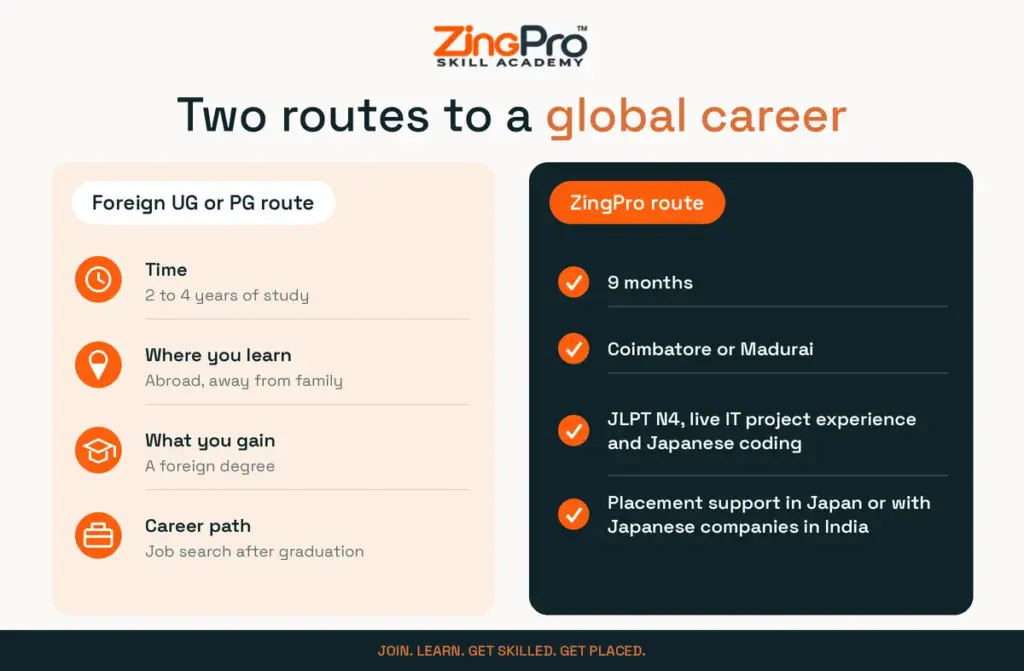
A foreign degree can provide international exposure, practical learning, professional networking, and access to local employers. However, students should not assume that studying abroad is the only route to an international career.
Before choosing a country or university, ask:
- What career do I want?
- Which countries have opportunities in this field?
- What skills do employers need?
- Do I need to learn the local language?
- What experience should I gain?
- What are the current visa and employment requirements?
This approach helps you focus on the career you want, rather than only the country where you want to study.
For example, an IT graduate interested in Japan could start building programming skills and learning Japanese while still in India. Later, they could explore opportunities with Japanese companies or international organisations.
The route may be different, but the career goal can remain the same.
What Do International Employers Look For?
A degree is important, but employers usually look beyond academic qualifications.
A strong candidate can combine:
- Relevant education
- Job-ready technical skills
- Practical experience
- Communication skills
- Foreign-language ability, where relevant
- Adaptability
- Understanding of workplace culture
Consider a software graduate.
Having a computer science degree shows academic knowledge. But a portfolio showing real applications, projects, internships, or other practical work gives employers more evidence of what the candidate can actually do.
The same principle applies to other professions.
Your qualification tells employers what you studied. Your skills and experience show what you can contribute.
What If You Cannot Afford to Study Abroad?
Studying overseas can involve significant expenses, including tuition, accommodation, travel, insurance, living costs, and visa-related expenses.
Students may also face challenges such as family responsibilities, entrance requirements, language tests, application processes, and visa requirements.
But not being able to study abroad immediately does not mean giving up on an international career.
You can use your time in India to:
- Complete your degree.
- Develop specialised skills.
- Gain internship or work experience.
- Learn a foreign language.
- Build a professional portfolio.
- Work with multinational companies.
- Research genuine overseas job opportunities.
- Prepare for future international applications.
Sometimes, building experience first can make a future international move more practical.
Can You Get an International Job Without a Foreign Degree?
In some professions and countries, yes.
The requirements depend on the job, employer, qualification, experience, and immigration rules of the destination country.
Technology is one example where practical skills can be especially important.
Germany’s official government portal identifies IT as an area with demand for skilled professionals and provides specific information for international IT workers.
Eligibility depends on factors such as your qualifications, work experience, job requirements, and the latest immigration rules. Job demand alone does not guarantee employment or a visa.
It does show why students should focus on becoming job-ready, rather than assuming that a foreign degree is the only possible route.
For an IT graduate, useful areas may include:
- Software development
- Cloud computing
- Cybersecurity
- Data analytics
- AI and machine learning
- Software testing
- DevOps
The right skills depend on current employer requirements, so always check recent job advertisements in your target market.
Why Learn a Foreign Language?
A foreign language can strengthen your profile when you plan to work in a country where that language is commonly used.
For example, students interested in Japan may consider learning Japanese.
The Japanese-Language Proficiency Test (JLPT) has five levels, from N5 to N1. According to the official JLPT information, N4 represents basic Japanese ability, including understanding familiar everyday material and relatively slow conversations.
However, a language certificate alone does not guarantee a job.
A stronger profile combines:
Foreign language + professional skills + practical experience + communication ability
Learning the language can also help you understand workplace culture and communicate more comfortably with colleagues and customers.
So, if you know the country where you want to work, starting the language early can be a smart career investment.
Why Japan Can Be an Option for IT Graduates
Japan can be an interesting international market for IT professionals with the right combination of technical skills, experience, communication ability, and Japanese-language knowledge.
For an Indian IT graduate, the goal should not simply be:
“I want to go to Japan.”
A better goal is:
“I want to become qualified to work for a Japanese or international technology company.”
That means preparing in advance.
A practical roadmap could be:
Step 1: Complete your IT or computer science qualification.
Step 2: Develop practical technical skills.
Step 3: Build real projects.
Step 4: Learn Japanese.
Step 5: Improve professional communication.
Step 6: Gain relevant experience.
Step 7: Research genuine Japanese employers.
Step 8: Check current employment and visa requirements.
This takes time, but starting early makes the process easier.
Start Preparing While You Are Still in College
You do not have to wait until graduation to think about your international career.
First year
Focus on exploring career options, improving communication, and understanding different industries.
Second year
Start building technical skills and small projects.
Third year
Look for internships, larger projects, certifications, and foreign-language training.
Final year
Prepare your résumé, portfolio, interviews, employer research, and applications.
This gradual approach is much easier than trying to develop everything immediately after graduation.
Early planning does not mean deciding your entire future today. It means giving yourself enough time to prepare.
Don’t Choose the Country Before Choosing the Career
Before choosing a destination, start by identifying the career you want to build. Different countries have different employer requirements, skill shortages, language expectations, and immigration pathways.
A better process is:
Career → Industry → Target country → Required skills → Language → Experience → Job applications
For example:
Goal: Software Developer
Industry: Technology
Target country: Japan
Skills: Programming, software development, testing
Language: Japanese
Experience: Projects and internships
Next step: Research current job opportunities
This approach helps you make decisions based on your career rather than following a popular destination simply because others are choosing it.
How to Build a Global Career Profile
You can start with a simple checklist.
Build professional skills
Choose skills that are actually requested by employers.
Gain practical experience
Internships, projects, freelance work, and relevant employment can strengthen your profile.
Improve communication
Practise explaining your work clearly and confidently.
Learn the target language
Start early if the language is important for your target market.
Build a portfolio
Show employers what you have actually done.
Research employers
Study real job descriptions and identify common requirements.
Understand visa requirements
Immigration rules differ between countries and can change. Always check official government information before making major decisions.
A Simple 12-Month Global Career Plan
You don’t need to do everything at once.
| Period | Focus |
| Months 1–3 | Choose career direction and research countries |
| Months 4–6 | Build professional skills and start projects |
| Months 7–9 | Gain experience and improve language ability |
| Months 10–12 | Prepare resume, portfolio and applications |
Your timeline may be shorter or longer depending on your career.
The important thing is to keep making progress.
What Should Parents and Students Consider?
A global career decision can involve a major financial and personal commitment.
Before paying for an overseas degree or training programme, consider:
- Total cost
- Course quality
- Career relevance
- Employment opportunities
- Required skills
- Current immigration rules
- Expected career outcomes
- Alternative options in India
Do not choose a programme simply because it promises a job abroad.
Before choosing an overseas education or career programme, ask exactly what support is included. “Placement support” can mean different things, so check whether it covers résumé preparation, interview training, employer connections, job applications, or other career services.
Clear information helps students make better decisions.
The Biggest Mindset Change
Instead of saying:
“I want to go abroad.”
try saying:
“I want to become globally employable.”
That small change can completely alter how you prepare.
You start focusing on skills instead of destinations.
You start building experience instead of waiting for opportunities.
You start learning a language because it supports your career—not simply because it looks good on a résumé.
You start researching employers instead of only researching countries.
Most importantly, you create more than one possible path toward your goal.
Conclusion
A global career does not have to begin with a plane ticket. It can begin with a skill, an internship, a project, or learning the language needed for your target market.
Instead of asking, “How can I go abroad?”, start by asking, “What do I need to become qualified for an international role?”
“What do I need to become qualified for this role?”
Studying abroad can be an excellent option, but it is not the only path.
The most important thing is to become skilled, experienced, adaptable, and ready for international opportunities.
So, start early.
Plan your career. Build your skills. Learn continuously. Gain experience. And keep your global opportunities open.
Ready to Start Building Your Global Career?
Start by choosing your career direction, developing job-ready skills, gaining practical experience, and learning the language required for your target market. With the right preparation and guidance, you can create more than one pathway toward an international career.